Showing posts with label Scholarships. Show all posts

Monday, March 9, 2009

The Letter of the Law: Bloggers Criticize Programs that do not Follow the Rules

It seems impossible these days to browse the news and not find a story about Bernie Madoff or other financial “gurus” breaking the law for personal gain. Yet while these scandals dominate the front pages, it seems as if there is an equal or greater amount of rule breaking to be found in the sports section. The National Collegiate Athletic Association publishes a large tome filled with a variety of intricate and complex rules, and seeks to punish programs that break them with matching force. This week I decided to look at two blog posts that examine different sides of the rulebook, and the way programs choose to, or sometimes not to, adhere to it. The first is a post on Deadspin titled “Florida State Punished for Cheating Scandal (But Not Really)” in which writer Dashiell Bennett argues that the relatively light punishments doled out to Florida State University for their program-wide academic negligence do not match the scope of the violations. In the second post titled “Capel and Griffin: Communication Without Speaking,” Thayer Evans, a freelance writer for the New York Times The Quad Blog, highlights the way University of Oklahoma men’s basketball head coach Jeff Capel was able to successfully recruit Blake Griffin despite the restrictions placed on the program due to indiscretions by previous head coach Kelvin Sampson. For convenience I have posted my responses to these posts on the respective blogs as well as below.


“Florida State Punished For Cheating Scandal (But Not Really)”

In posting this you are in effect catching the NCAA in the act, showcasing the absurdity and inconsistency of the association in handing out punishments. I think you successfully deconstructed the restrictions doled out by the NCAA and showed how these supposed tough restrictions mean very little to the athletic program’s most important teams. However I think the extent of the problem goes much further than you indicate in your analysis.

I think there is no question that the prominence of Florida State University’s athletic program helped minimize the severity of the penalties. While their football program is losing a total of five scholarships over three years, the New Mexico State Lobos are able to offer five fewer scholarships annually, twenty instead of twenty-five, and reduce total scholarships from eighty-five to eighty for the next three seasons for similar transgressions. The Lobos athletic director indicated that the NCAA is moving to increase the severity of sanctions for programs caught breaking the rules and that “we’re one of the first cases experiencing that, if you will, get-though policy.” And it would appear to be the only program so far, having its ruling handed to it just over a week before Florida State got a slap on the wrist. Do you think the presence of Rhodes scholar Myron Rolle (pictured right) on the football roster played a part in minimizing the penalties? Does the one bright individual make up for a batch of bad eggs?

You also raise the issue that even though they may have to vacate victories that were accomplished with ineligible players “no one will ever forget that the really did win it.” I think another facet of this is that while the individuals may have failed to uphold the first, and theoretically more important, half of the “student-athlete” moniker, they proved themselves to be the more capable players. They are not going to be remembered for being valedictorian, but they will be remembered for the touchdowns they score. Yet do you see this as encouragement for the school to work harder for athletes’ academic success or a situation that will simply lead to a lower graduation rate? The other matter at stake is the personal achievements of head football coach Bobby Bowden. Especially in a sport like football where it takes a minimum of twenty-two men to field a competitive team, it seems unfair to lose victories that featured only a handful of these ineligible players. Once again the prominence of the program involved makes it likely that the NCAA will not tarnish the records of one of college football’s most recognizable and longest tenured coaches.

So I will put the ball back in your court, so to speak. Do you feel that there is an adequate punishment the NCAA could have doled out to match this crime? And more importantly, is there any real obligation on Florida State, with one of the worst graduation rates among athletes, to improve their academic success scores?


“Capel and Griffin: Communication Without Speaking”


Reading this post truly helps me understand just how absurd some of scandals in college athletics are, when some individuals are willing to work so hard to follow the letter of the law. It brings to light one of college sports “good guys,” as coach Capel (pictured left with Griffin) was able to build a friendship with a player despite even stricter recruiting regulations resulting in place because of former head coach Sampson.

I think that while this story does highlight the exceptional efforts of one coach to restrict himself to the letter of the law, it also reflects some of the failures of the NCAA in regulating the recruiting process. This story deals with the recruitment of Griffin once he was a junior, but what it doesn’t mention is that he was probably getting harassed like this on a daily basis since he was in the eighth grade. I do not mean to imply that Capel was harassing Griffin, but simply that while Capel was trying to attract all of Griffin’s attention, so were the dozens of other coaches vying for the big man. As you say “the back and forth would not end until…he went to sleep for the night.” And now the NCAA has extended prospect status to seventh graders, meaning coaches wishing to converse with them must do so in accordance with recruiting guidelines. There is no question that the emotional bond between player and coach is one of the key aspects of college basketball, but I would put forth the question, how early it too early to start developing that connection? Would this frequent text messaging have been something to commend had it been occurring for four years instead of a few months?

The fact that the two communicated extensively over text messaging not only reflects the willingness of the coach to play by the rules, even if it was a mere technicality that permitted it, but also his willingness to adapt to the preferences of his players. In that light, I wonder what you feel are the biggest impacts of the NCAA decision to ban coaches from text messaging recruits? I think this complete ban is yet another signal that the NCAA is failing to adapt some of its archaic structure to modern sentiments and developments in current technology. Most college students now prefer text messaging with their friends to any other form of communication such as calling, or e-mailing, and I believe instant messaging isn’t at the top simply because it has not yet become a fully enabled mobile technology. Do you see the NCAA reversing this decision in the future? Do you think the NCAA could actually create greater recruiting equality by restricting coaches to their offices and only allowing communication through technological means?

Monday, February 23, 2009

Follow the Money: Voices of Reason Around the Web

In searching the blogosphere for the latest developments in the sports world, it seems that many bloggers echo my concerns about the financial situation of college athletics programs. I find it important to seek out and engage different sources of information because in the digital age opinions are plentiful, and while there may be common ground between them, no two are ever the same. In my search it quickly became apparent that the two widespread sources of concern are the state of athletics budgets given the current fragility of the economy, and the financial controversies involving student-athletes that consistently capture national headlines. The first post I will examine this week is by Connor Ennis, a copy editor of the sports section for the New York Times, and is titled “A Question About Calhoun’s Salary.” Connor brings attention to comments made by University of Connecticut men’s basketball head coach Jim Calhoun about his salary as the highest paid state employee in a state facing a budget deficit. I will also challenge some of the assumptions and address some of the questions raised by a blogger for The National Sports and Entertainment Law Society in the post “Does Age Matter?” In this post the author addresses both the NBA age limit and differing theories on compensation for student-athletes. For convenience I have posted these responses here, as well as at the respective blogs.


“A Question About Calhoun’s Salary”

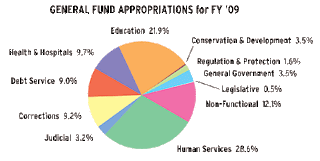
I am glad someone else in the blogosphere is perplexed by the large sums being invested in athletics programs by state institutions that are facing a budget shortfall. Jim Calhoun argues with the reporter to “get some facts,” but these facts show that Calhoun is playing with fuzzy numbers. The state of Connecticut is facing a budget shortfall of over $900 million this year, and could top $8 billion over the next two (see chart on left for a budget breakdown). If the state is forced to reduce the number of teachers, then the students who attend school to receive an education, not audition for a professional athletics contract, will suffer. This is especially pressing in a state where more than half of students enrolled in 4-year public colleges have not graduated within six years. Calhoun argues that his team and its success, which presumably he plays a rather large part in, helps bring in a profit of $12 million for the university. But recent athletics budget reports show that while this helps support athletic programs, the university still contributes a net of $2 million to the athletic department annually to help cover all the expenses. This number is subject to the 3.5% budget cut the university is enacting in response to a $9 million reduction in state funding. Adding to this is the fact that coaches’ salaries constitute nearly 40% of athletic department expenses. I think this makes it clear that it would be very beneficial if coaches voluntarily cut their pay to help the university.

What is even more disturbing is Calhoun’s lack of sympathy for the hardships that individuals around the state of Connecticut and the nation are facing. His behavior brings to mind awful memories of Latrell Sprewell’s contract complaints when he felt that $14 million was not an adequate sum of money to adequately take care of his family. Calhoun’s statements also reflect that he is in effect hoarding his money, saving it for his retirement, rather than using it to the benefit the economy by spending more disposable income. I am curious to see what your opinion is on this issue. Do you feel that this backlash is warranted against programs with spending that can be deemed reckless in the face of the economic crisis? I think this situation epitomizes the problem in college athletics today, but I am curious to about what you think? Is this a problem? What do you think the future holds?


“Does Age Matter?”

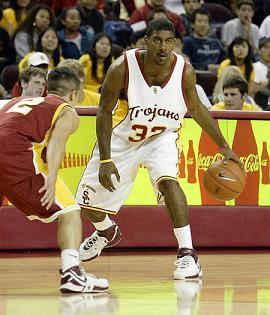
One important aspect of OJ Mayo’s career that you overlook is that he was 20 years old during his time at USC. His “advanced” age gave him a physical and mental advantage compared to other freshman players. He must have also carried the concern that delaying the start of his NBA career would have put him at a disadvantage against players who were younger and shared the same amount of college experience. But for individuals who would enter the NBA directly out of high school, the college experience provides an intermediate step in terms of skill and the demands of increasing exposure. Only the MLB minor league system offers a similar experience where the demand is increased gradually, and thus it protects itself against issues that an age limit would counter. I would argue therefore, that the age limit is simply an insurance policy for the teams that would dole out millions of dollars on otherwise unproven talent. But perhaps for OJ and other players of his ilk, the most important consideration was the one I address below.

The second issue you raise in this post is the question of payments to student-athletes, something that has been going on under the table for years, but has seen increased exposure given the recent scandals you mention. The increased exposure the players get in college is good for all the parties involved, and there is no reason the players shouldn’t see a profit as a result. The players themselves are rewarded through greater endorsement deals and an established, dedicated fan base that they carry throughout their pro careers. For the colleges this means increased interest, which results in greater ticket sales and a large boost in merchandise sales. The NBA teams that draft highly developed players, both in terms of talent and marketability, see a similar boost in their bottom line as a result. Allowing players to leave for teams overseas only serves to diminish their earning potential. It would seem that the current rules are not realistically enforceable as the number of cases that slip by the radar is becoming more and more apparent. Obviously allowing players to be paid would result in an imbalance between those programs that see a profit and those that do not. Keeping that in mind, do you support college athletes being rewarded above and beyond covering their expenses (including ones not currently covered by scholarships)? In effect aren’t schools already “purchasing” players through the construction of better facilities, and more expensive student-athlete support programs? Where should the line be placed between what is considered legal aid and what is considered a breach of rules or ethics?
 
Creative Commons License
This work is licensed under a Creative Commons Attribution-Noncommercial-No Derivative Works 3.0 United States License.